Deadlock Cheat Safety and VAC Protection Explained: Why Cheats are Safe?
Greetings, everyone. The question for today matters to anyone who plays Deadlock: are cheaters really getting banned by Valve, and how exactly does it hunt them down?
My conclusions come from official numbers, countless hours with Deadlock cheats running and from taking VAC apart myself. For readability, the text has a few big blocks: a quick explanation of the way cheats function (and why they evolved into game assistants), then official ban figures, the detection methods Valve uses and the tricks modern cheats use against them, and a closing summary on why Deadlock cheaters avoid bans and why you might want to try cheating too.
The Short Version
- Within its category, VAC ranks among the strongest anti-cheat systems.
VAC can still be bypassed with drivers and extremely sophisticated math-based systems. Humanizer is one of them. - Humanizer imitates mouse movement plus whatever commands go to the game server, leaving the anti-cheat system unable to tell what the cheat does apart from what a human player does
- The deadlock cheat from cluster.center is the best in its category and gives the strongest possible protection against VAC
What features can modern cheats offer?
Cheats for Deadlock were always rare, and today only a single one is really left in the game — Cluster (link active) — and I have been playing with it practically since launch day.
Building them is extremely difficult. A basic aimbot does the trick for an FPS game, but Deadlock layers a huge number of mechanics over its FPS gameplay, so it needs a tailored approach.
No deep dive here, only a broad outline of today’s capabilities. A dedicated article about what cheats can do in Deadlock is coming a bit later.
Aimbot
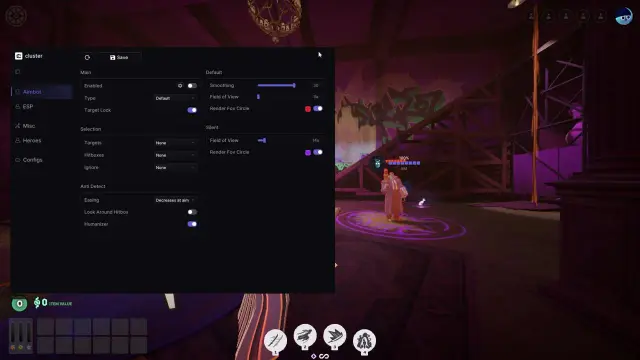
At the core of most Deadlock cheat features sits the aimbot as the main mechanical block. Put plainly, it is aim assistance built as a system. It exists to keep the player’s aim nearer to the chosen target while still leaving the settings open to tuning.
The three aim modes are:
- Default.
- Silent.
- Default plus silent.
Default is the simplest one to grasp. It is the visible style of aim assistance: the player notices the correction through how the crosshair or camera moves. Silent tends to be described as an aim assistance mode where the assistance is less visibly obvious, though we will keep that explanation at a general level here. Default plus silent simply means one type option that merges both styles.
That same basic logic explains why aimbot settings are so important. A crude aim tool gets spotted easily and feels bad to use. With finer control, the player gets to decide on the strength of the assistance, what it goes for first and how it acts in different fights.
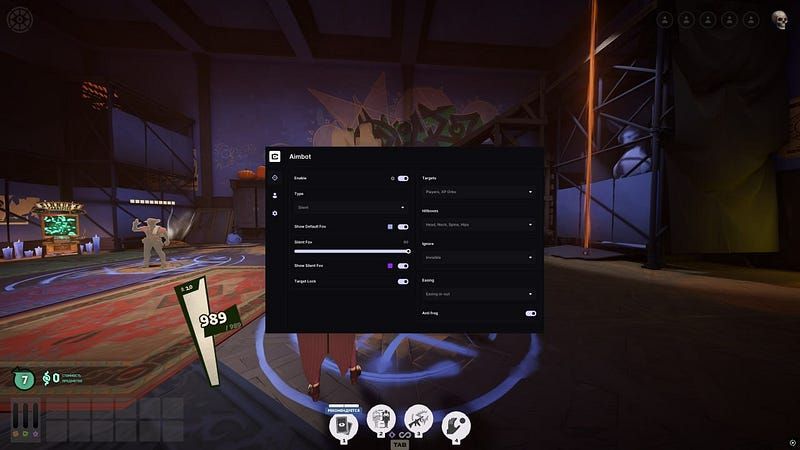
FOV, Smooth and Target Lock
In a Deadlock aimbot, FOV tends to be among the very first settings players check. It sets the zone around the spot you are aiming at, inside which the assistant may pay attention to targets. With a wide FOV the tool feels more aggressive. With a narrow FOV it feels pickier.
Cluster’s Deadlock features also include:
- Show default FOV.
- Show silent FOV.
- Smooth.
- Target lock.
Displaying the FOV is there for readability. Instead of guessing, the player sees exactly where the active zone is. With separate displays for the default and silent FOV, it becomes obvious how each aim assistance feature and each of the modes looks different on screen.
Smooth sets how abrupt the movement of aim assistance is. In practice, smooth is the thing that stops the tool from feeling overly robotic. A hard snap may look unnatural and can feel awkward in an actual fight. A softer curve is easier to handle, since you feel a gentle correction rather than a yank.
Target lock is about commitment. After a target is picked, target lock keeps the assistant on it rather than hopping every time someone else walks across the screen. Deadlock fights fill up with bodies quickly, so this counts. Nobody wants the assistance overriding the calls they make themselves.
What It Can Target: Players, Creeps and XP Orbs
One curious detail among Deadlock cheat features: the aimbot targets more than just heroes. Its target categories are:
- Players.
- XP orbs.
- Creeps.
Everyone expects players as a target category. This is the textbook scenario for aim assistance: trades, chases and one-on-one duels.
XP orbs are far more specific to Deadlock. They count because winning Deadlock is about more than gunning down enemies; lane control, the rhythm of farming and denying resources all matter too. Having XP orbs as a target category shows the tool was designed around how the game is actually structured, not just raw fighting.
Creeps serve a similar practical purpose. Farming, controlling waves and applying pressure all involve them. When a cheat lists creeps among its features, it is plainly aiming to handle the dull yet crucial side of Deadlock as well. That is frequently where games are won or lost: not through one showy kill, but through a hundred little moments that make your lane smoother or rougher.
Easing and Anti Frog
Easing describes how aim movement feels as it plays out. It separates a flat, even correction from one whose speed shifts along its path.
The available easing modes are:
- Easing in-out.
- Static.
- Decreases when aiming.
- Easing out-back.
Static reads as the most straightforward behavior: steady movement with hardly any curve. Easing in-out hints at a gentler start and end. Decreases when aiming hints that the assistance gets gentler after the aim has settled. Easing out-back reads like a movement curve with some style to it. You do not need the precise math here, and guessing at it would be a mistake. What a reader should take away is the purpose: with easing, the tool has a distinct feel rather than a bare strength value.
The Deadlock aimbot section also lists an option called anti frog, but the available feature description does not explain how it works.
ESP
The second major category is visual information. For Dota, as an example, the visual features include additional info on screen and comfort tied to the camera. As for Deadlock, cluster.center labels the visual-awareness category ESP.
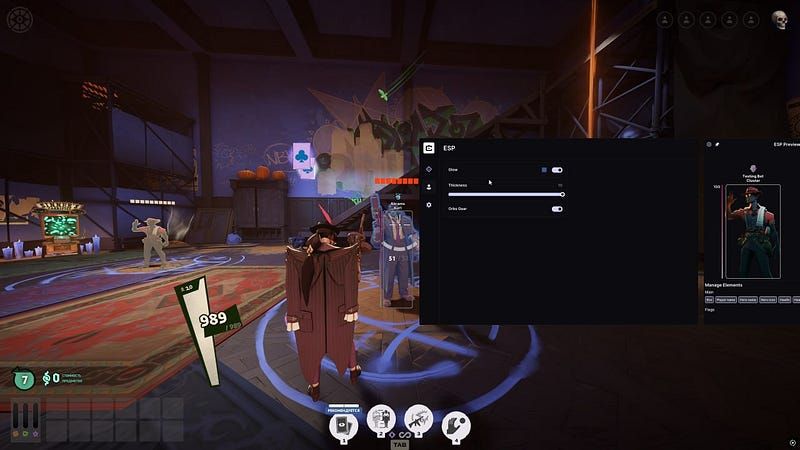
ESP is more than a single feature. It is a set of stacked visual layers that speed up how you read heroes, players, HP and objects on the map.
These are the ESP elements on the list:
- Box.
- Player name.
- Hero name.
- Hero icon.
- Health.
- HealthBar.
- Glow.
- Thickness.
- Orbs gear.
Box is the base outline layer, drawing a quick frame around whoever you are aiming at. The player name and the hero name each answer their own question: who controls this character, and what hero is it? Hero icon delivers that same information faster when reading text mid-fight is not an option.
Health and healthBar serve your decisions. They show whether a target deserves the chase, whether to pull back, or whether that fight is lost anyway. Glow adds a layer of visibility. Thickness governs readability, which helps most when the screen is busy.
Orbs gear is the entry in the ESP list that feels most like Deadlock. The feature description does not explain it further, so its precise function remains unclear.
Misc Features
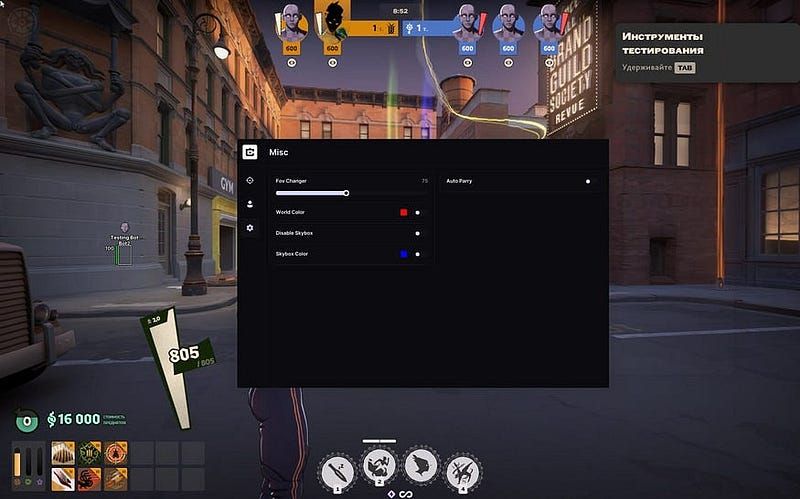
In the Misc category, the Deadlock feature set from cluster.center goes beyond direct aim and ESP toward comfort, visibility and assistance with movement.
The Misc features include:
- FOV changer.
- World color.
- Disable skybox.
- Skybox color.
- Auto dash jump.
- Auto parry.
FOV changer serves visibility. It changes the amount of the world you can comfortably take in. Much like a camera feature improves the feel of the Dota game, tweaking the FOV can make Deadlock look tidier and easier to follow.
For customization there are world color and skybox color features. With them, the map becomes less tiring to look at, or heroes and effects stand out more sharply against the surroundings. Disable skybox belongs to the same comfort group: less clutter on screen, more attention on what matters in the fight.
Auto dash jump and auto parry fall under utility assistance. These automation features assist with movement or defensive actions where timing is everything.
What is Valve doing about cheaters in Deadlock?
To start, let me correct a widespread myth: that Valve is “doing nothing” about cheaters. The claim gets repeated a lot in comment sections, yet it does not hold up. Valve operates an anti-cheat ecosystem that is among the most advanced the industry has, and calling it a basic scanner would be wrong. The approach mixes VAC, analysis on the server, behavior checks, pattern detection in the style of neural networks, and systems able to move suspicious players away from regular matchmaking.
That is precisely why serious Deadlock cheats you can trust are so few, not dozens, over the long run. Cheating in a Valve title takes more than a menu full of features. It also takes people who know how Valve spots abnormal behavior, how its server checks operate and what it takes for assisted play to pass as human.
This is a big part of why cluster.center stands apart in Deadlock. Nobody pitches it as a pasted tool with a handful of random switches. It is a complete Deadlock cheat offering aim assistance, silent aim, ESP, FOV tools, help with movement, auto parry and visual customization, backed by a Humanizer system built to make assisted actions resemble the way real players behave.
Valve Anti-Cheat
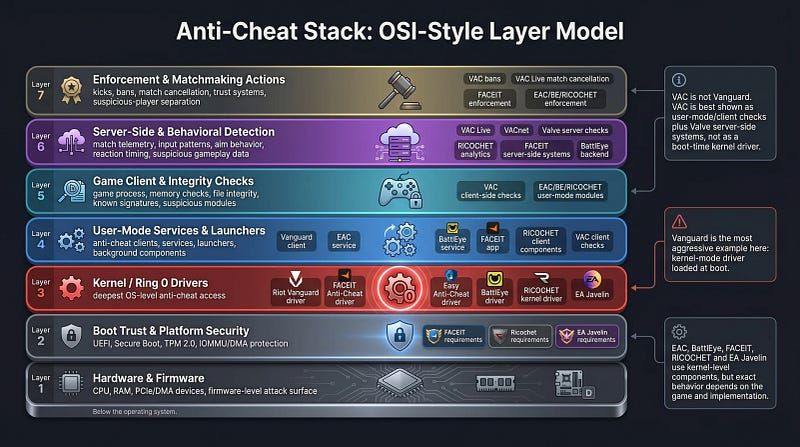
VAC and Vanguard are anti-cheats of different kinds. VAC does not load in the kernel during early boot, ahead of Windows, to run the system from its lowest layer. For the most part it stays in user space and works through Valve’s own ecosystem of games and servers.
The difference matters a lot. Given the level VAC runs at, there are limits to what it can see on a PC directly. It is not designed like kernel anti-cheats, for instance, which can dig into drivers, low-level system activity or anything that runs beneath ordinary user-mode software.
The majority of game anti-cheats sit nearer to this ordinary software level. Aggressive kernel-level protection like Vanguard is the exception, and it is famous for running far deeper inside the system.
None of this makes VAC weak by default. It just means Valve went with another model. Rather than forcing every player to install a bulky anti-cheat driver, Valve counts on a system mixing client checks, checks on the server, delayed detection and analysis of behavior.
The debate around kernel anti-cheats
System-level or kernel-level anti-cheats are usually seen as stronger, yet they carry real trade-offs. Since they sit so deep, they are technically able to reach far more of the PC than an ordinary game process ought to. That raises clear privacy worries.
Compatibility is a hands-on issue too. Kernel anti-cheats may conflict with other games, ordinary software and even rival anti-cheats. Plenty of players ran into this with Vanguard, when certain games or services would not run properly while it was active. At times a reboot was the only cure.
Valve could create something similar if it chose to. For its own ecosystem, though, Valve tends to pick a more universal path: VAC, deeper checks on the server and behavioral detection, rather than making every player run a Vanguard-style driver.
The four software layers
To see why this is important, it is useful to sort anti-cheats by where in the system they operate.
At its simplest, in user mode, the anti-cheat keeps an eye on the game process, scans files, searches for known signatures and confirms the client acts normally. VAC mostly falls into this group, although Valve pairs it with systems on the server side as well.
Over on the server, the game can study all the data a player transmits in a match: inputs, movement, damage, reaction timing, aim habits, how targets get switched, and many more gameplay signals. In Valve games this is hugely important, since even a perfectly hidden client-side program cannot stop the server from getting the outcome of what the player does.
On the level of behavioral analysis, systems can measure a player’s behavior against what real people normally do. When someone reacts too flawlessly, aims too mechanically, flicks between targets too quickly or repeats actions with robot-like timing, the pattern may start to look suspicious.
Down in the kernel, starting at early boot, anti-cheats such as Vanguard reach much deeper into the operating system. Their view is wider, and so are the privacy and compatibility issues they bring.
VAC is not Vanguard, and it was never meant to be. Valve built its approach around a broader system: checks on the client, checks on the server and analysis of behavior.
What VAC typically looks at
VAC is able to inspect game integrity, running programs, suspicious modules and signatures of cheats it already knows, and to see whether the client was altered in ways that fit known detection patterns.
That is the traditional side of anti-cheat work: find what is running, find what interferes with the game, find out whether anything looks wrong in memory or the game files.
Yet on its own this no longer cuts it. A modern cheat does not always get caught because its file is detected. It can also get caught because the way it plays looks inhuman.
And that is the reason server checks carry so much weight.
Server checks
Among the strongest pieces of Valve’s system are its server checks. They have no need to see each detail of what sits on your PC. Instead, they can examine everything coming from the player to the server mid-match.
In something like Deadlock, that may cover aim behavior, picking targets, the rhythm of movement, when abilities and parries are used, dash use, tracking, how fast you react, how damage is dealt and the speed at which the player shifts between target types.
Simple cheats tend to break down right here. A crude aimbot can snap far too hard. A poor silent aim can look unrealistically perfect, and a helper for movement may create timing no ordinary player has. Any tool reacting instantly, the same way each time, can expose itself through behavior, even before the anti-cheat picks up the program directly.
That is precisely what Valve built its approach on the server side for: it examines the cheat, and also the outcome the cheat produces in the match.
Why a modern Deadlock cheat needs more than a feature list
Here the key point becomes obvious: no Deadlock cheat can last on aimbot or ESP alone. Features are what you see on the surface. What lies underneath is how those features act.
And this is exactly where cluster.center differs from simple tools.
cluster.center ships the features Deadlock players really want: silent aim, default aim and default + silent aim together, plus FOV settings with visible FOV indicators, smooth aim, target lock, picking targets among creeps, XP orbs and players, hitbox choice (head, neck, spine and hips), along with ESP elements such as boxes, player names, hero names, hero icons, health, health bars, glow, thickness settings and orbs gear.
Add to that general Deadlock tools like FOV changer, world color, disable skybox, skybox color, auto dash jump and auto parry.
Still, the feature list is not where the real value lies. What matters is that cluster.center comes with Humanizer as well.
cluster.center and its Humanizer
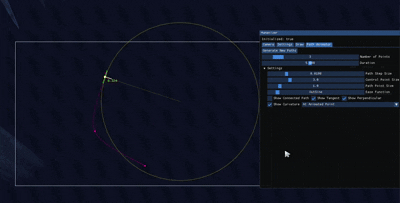
In today’s cheats for Valve titles, Humanizer ranks among the most crucial systems. It exists to make assisted play look closer to how ordinary humans play, rather than like a machine is running the show.
Put simply, Humanizer reshapes how cheat-assisted actions show up in the match. Aim must not snap flawlessly and instantly every time. Target switches must not resemble a robotic lock-on. Assistance reactions should not be mathematically identical. Help with movement and combat should not keep producing the same unnatural pattern over and over.
In Deadlock this is a big deal, because the game blends shooter aiming with decision making in the MOBA style. A player does far more than shoot. They move up and down, react to heroes, pick up XP orbs, battle creeps, cast abilities, dash, parry, watch health and make split-second calls in messy fights.
Lacking Humanizer, assisted play can turn out too clean and too uniform. Thanks to Humanizer, anyone watching cluster.center at work sees assisted actions that feel natural rather than machine-made.
What Humanizer does for you in Deadlock
Aim assistance is the simplest case to look at. When a basic cheat yanks to the same hitbox at the same speed with the same timing in every fight, that is nothing like how real people aim. Human aim has tiny variations. At times the movement is smoother, at times slower, and at times the player corrects in the middle of the fight.
The Humanizer in cluster.center matters because it is built around input that looks natural. Smooth aim features, FOV-based control, silent aim, hitbox choice and target lock all need to behave so that no two fights look exactly alike.
The same logic carries over to the categories of targets: Deadlock is about more than shooting enemy heroes. Players deal with XP orbs and creeps too. If a cheat deals with creeps, orbs and players using perfect machine timing in every case, the pattern starts to seem odd. With Humanizer, assisted actions resemble what a real person might do in a hectic fight.
That is why Humanizer is much more than a bonus checkbox. It forms part of the central protection logic in any serious Deadlock cheat.
Camera, visuals and the information edge
Deadlock also comes with a big layer of visual information. ESP features help because they let the player grasp what is going on more quickly: boxes, hero icons, hero names, health bars, glow and orbs gear all make a fight clearer at a glance.
Visual features, however, have to sit naturally within the game as well. A decent cheat should never feel like a glitchy overlay that leaves the screen unreadable. It ought to add helpful information without turning each fight into visual noise.
cluster.center solves it with visual settings and ESP customization. The player has skybox options, world color, FOV changer, awareness features and more visual tools so the game is easier to read.
That is one more reason clustercheats.com offers more than any basic Deadlock cheat. Aim is only part of it. It also boosts awareness, visibility and comfort.
cluster.center as the top pick for Deadlock
A primitive cheat cannot cope with how complex Deadlock is. Aim assistance is a must, and so are clean visuals. Silent aim is a must, and so is smoothness. Target lock is a must, and so is behavior that looks human. ESP is a must, and so is information you can actually read. Automation such as auto parry or auto dash jump is a must, yet inside the match it must feel natural.
clustercheats.com brings all of that together in a single product.
Deadlock players get the complete feature set: silent aim, default aim, default + silent aim, smooth aim, FOV settings, target lock, hitbox choice, targeting of players/orbs/creeps, ESP, health info, glow, world color, FOV changer, skybox controls, auto parry and auto dash jump.
Most importantly, Humanizer is part of the package — it lets assisted play resemble human play instead of obviously scripted behavior.
That is what separates a random cheat from a serious solution for Deadlock. Random cheats just sell functions, while cluster.center gives you those functions plus aim assistance, visual control, assistance for movement and protection backed by Humanizer, all inside one product built around Deadlock.
Final Thoughts
Deadlock cheat features are easy to make sense of once you sort them by what they do. Aimbot takes care of targeting. ESP takes care of visual information. Misc tools cover comfort, visibility, movement and assistance with timing.
That is the straightforward way to sum up what cluster.center can do in Deadlock: packed with features, well organized and aimed at whatever players find hardest in the game. It still cannot guarantee a win, and it does not make risk disappear, yet it does show why players see modern Deadlock cheats less as one rough hack and more as a complete game-assistance toolkit.
Curious to experience Deadlock differently and actually have fun with it? Click the link I shared earlier and grab a 7-day trial period for free, or type cluster.center into your search bar. Appreciate you reading — until next time!